

20/11/2025 0 Comments
AI-Generated Brain Vessel Trees for Stroke Research
Synthetic vessel-generation framework offers a scalable path toward richer in-silico clinical trials (ISCT) datasets and improved simulation fidelity.
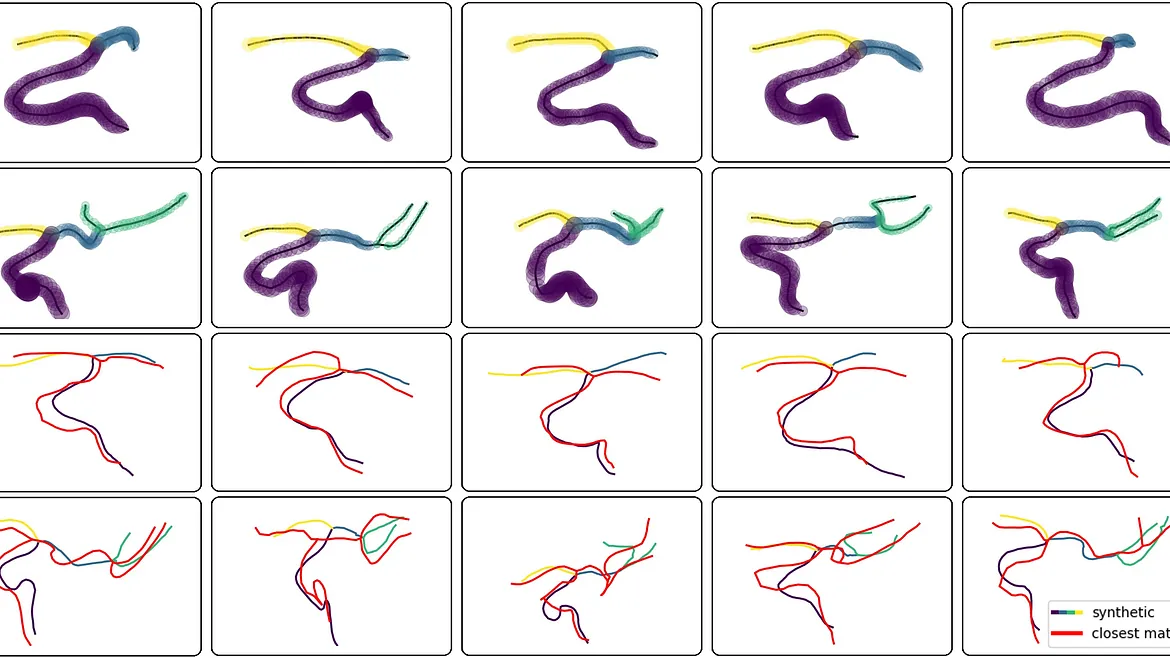
Acute ischemic stroke (AIS) remains a leading cause of mortality and disability worldwide, and developing effective treatments relies on access to large populations of accurate anatomical data. Generating such datasets manually for in-silico clinical trials (ISCTs) is labor-intensive and time-consuming. To address this challenge, our team has developed a novel diffusion-based generative model with a set-transformer backbone capable of producing synthetic cerebral vessel trees, as described by Thijs Kuipers et al. in their work Generating Cerebral Vessel Trees of Acute Ischemic Stroke Patients using Conditional Set-Diffusion.
The model generates vessel centerlines annotated with radii and vessel types and can be conditioned on clinically relevant factors, such as occlusions in the middle cerebral artery, a common site of AIS. A simple sequencing algorithm connects points and vessel segments effectively, producing artifact-free and anatomically realistic centerlines. Experiments show that the model captures geometric variations between vessel segments while producing diverse and complex vascular structures that reflect the characteristics of real patient data, without merely replicating the training set.
By generating large populations of realistic vessel geometries, this approach provides a scalable solution for ISCTs and computational vascular modeling. The synthetic samples closely resemble datasets previously validated for in-silico stroke treatment simulations, highlighting their potential utility in downstream applications.
This advancement represents a significant step toward accelerating stroke research, reducing reliance on labor-intensive manual data collection, and supporting precision medicine initiatives.
Image: Synthetic vessel trees. The bottom two rows display the skeletons with the closest
match from the training set. From Generating Cerebral Vessel Trees of Acute Ischemic Stroke Patients using Conditional Set-Diffusion (Thijs Kuipers et al., 2024).
Comments
Leave a comment